Thirty figures on scale, scam types, who carries the most harm and what has cut losses, each read at the issuing body's own page in October 2026, with its date, its type and a direct link. Reported losses are what people told an agency they lost, and they are always lower than the real total, because most fraud is never reported.
Charts
The figures
| Figure | What it measures | Source and date |
|---|---|---|
| US$20.9 billion | Lost to internet crime reported to the Federal Bureau of Investigation in 2025, across 1,008,597 complaints United States · Reported losses | Federal Bureau of Investigation, Internet Crime Report 2025, April 2026 |
| US$15.9 billion | Fraud losses reported to the Federal Trade Commission in 2025, from 3 million reports United States · Reported losses | Federal Trade Commission, testimony to the Joint Economic Committee, 25 March 2026 |
| US$2.1 billion | Reported losses to the Federal Trade Commission in 2025 from scams that began on social media United States · Reported losses | Federal Trade Commission, 27 April 2026 |
| £1.28 billion | Stolen through payment fraud in 2025; £576.4 million of it through scams where people were tricked into sending money United Kingdom · Reported losses | UK Finance, Annual Fraud Report 2026, June 2026 |
| A$2.18 billion | Reported scam losses across five Australian sources in 2025 Australia · Reported losses | National Anti-Scam Centre, Targeting Scams Report 2025, 30 March 2026 |
| C$704 million | Lost to fraud across more than 112,000 reports in 2025 Canada · Reported losses | Canadian Anti-Fraud Centre, 25 February 2026 |
| S$913.1 million | Lost across 37,308 scam cases in 2025, down from about S$1.1 billion Singapore · Reported losses | Singapore Police Force, Annual Scam and Cybercrime Brief 2025, 25 February 2026 |
| 1 in 7 | Frauds that reach the police or Report Fraud England and Wales · Official survey | Office for National Statistics, Crime in England and Wales: year ending June 2026, 22 October 2026 |
| US$7.228 billion | Lost to cryptocurrency investment fraud reported to the Federal Bureau of Investigation in 2025, across 61,559 complaints United States · Reported losses | Federal Bureau of Investigation, Internet Crime Report 2025, April 2026 |
| US$1.4 billion | Lost to recovery scams in 2025, across 10,516 complaints (may include the earlier scam) United States · Reported losses | Federal Bureau of Investigation, Internet Crime Report 2025, April 2026 |
| US$389 million | Lost through cryptocurrency kiosks in 2025, across 13,460 complaints United States · Reported losses | Federal Bureau of Investigation, 15 May 2026 |
| US$362.9 million | Lost to employment fraud in 2025, across 24,688 complaints United States · Reported losses | Federal Bureau of Investigation, Internet Crime Report 2025, April 2026 |
| US$3.5 billion | Reported lost to imposter scams in 2025 United States · Reported losses | Federal Trade Commission, 15 June 2026 |
| US$90m to US$501m | Reported losses to job scams, 2020 to 2024 United States · Reported losses | Federal Trade Commission, 10 March 2025 |
| US$470 million | Lost to text scams in 2024; fake delivery texts were the top type United States · Reported losses | Federal Trade Commission, Data Spotlight, 14 April 2025 |
| Up 102.4% | Job scam reports in 2025; losses up 81.5% to A$24.8 million Australia · Reported losses | National Anti-Scam Centre, Targeting Scams Report 2025, 30 March 2026 |
| 1 in 5 | Complaints to the Federal Bureau of Investigation in 2025 came from people aged 60 and over, who reported US$7.7 billion, 37% of the money lost United States · Reported losses | Federal Bureau of Investigation, Internet Crime Report 2025, April 2026 |
| 26.5% of losses | Reported by people aged 65 and over, who are 17.1% of the population (2025) Australia · Reported losses | National Anti-Scam Centre, Targeting Scams Report 2025, 30 March 2026 |
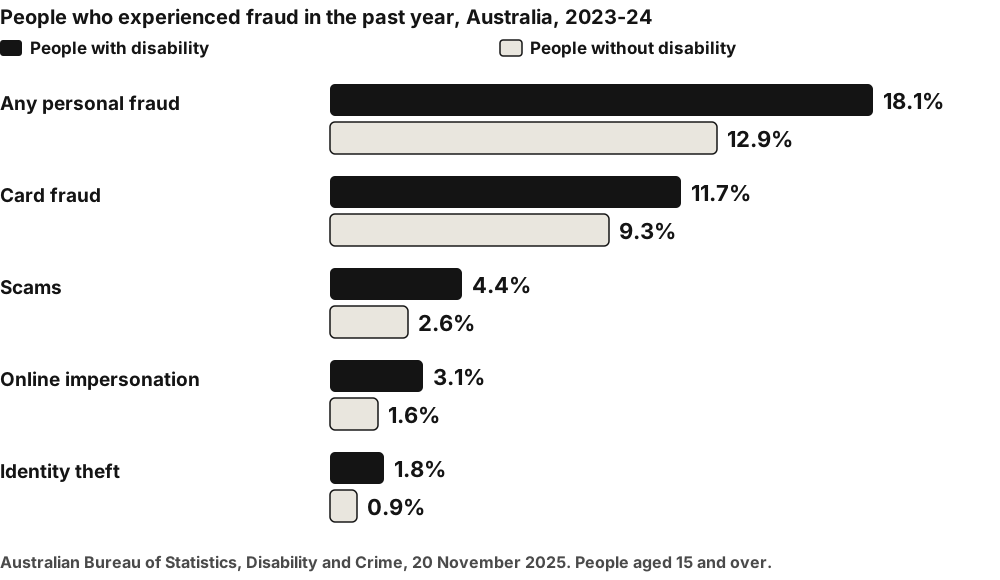
| 18.1% vs 12.9% | Disabled people and people without disability who experienced personal fraud in a year (2023-24) Australia · Official survey | Australian Bureau of Statistics, Disability and Crime, 20 November 2025 |
| 66.6% vs 74.5% | Disabled and non-disabled card fraud victims who got a full refund (2023-24) Australia · Official survey | Australian Bureau of Statistics, Disability and Crime, 20 November 2025 |
| 18% vs 9% | Disabled adults and all adults who experienced fraud in 2025 New Zealand · Official survey | Ministry of Justice, New Zealand Crime and Victims Survey, 7 May 2026 |
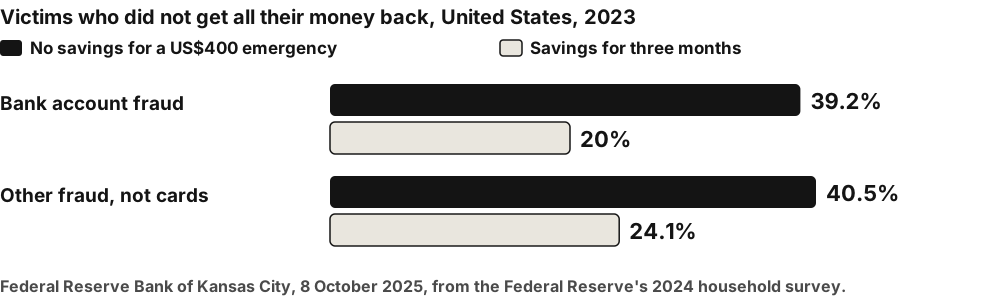
| 39.2% vs 20.0% | Bank-fraud victims without all their money back: no savings for a US$400 emergency against three months of savings (2023) United States · Official survey analysis | Federal Reserve Bank of Kansas City, 8 October 2025 |
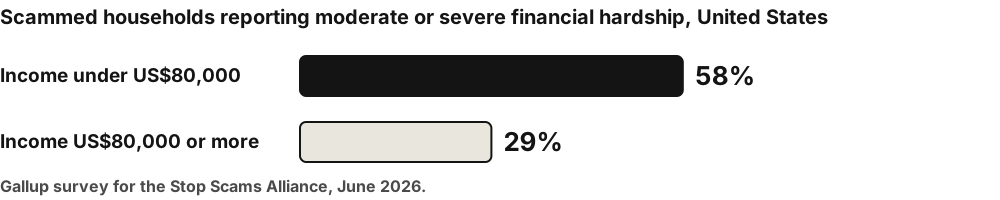
| 58% vs 29% | Scammed households reporting moderate or severe hardship: under US$80,000 against US$80,000 or more United States · Survey | Gallup for the Stop Scams Alliance, June 2026 |
| US$400 | Median fraud loss for adults earning under US$50,000 in 2025; 20% of all adults experienced fraud or a scam United States · Official survey | Federal Reserve Board, Economic Well-Being of U.S. Households in 2025, 13 May 2026 |
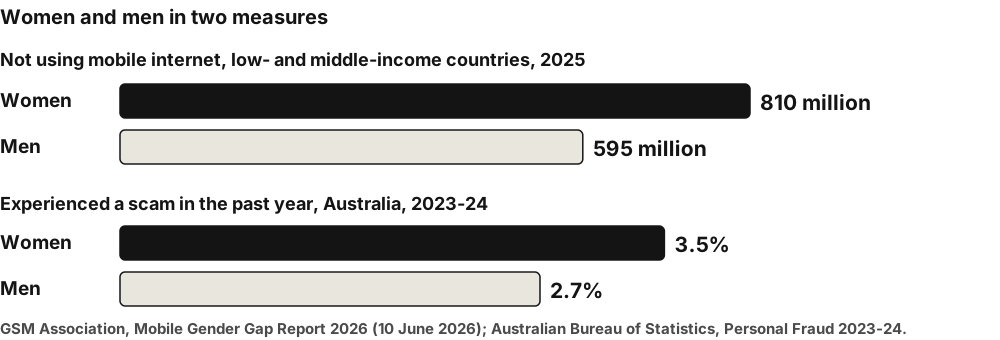
| 810m vs 595m | Women and men not using mobile internet; women name safety and security as their top barrier Low- and middle-income countries · Industry survey | GSM Association, Mobile Gender Gap Report 2026, 10 June 2026 |
| 2.2 billion | People not using the internet in 2025 World · Official estimate | International Telecommunication Union, Facts and Figures 2025, 17 November 2025 |
| 54% to 65% | Share of scam losses by value refunded before and after banks were made to pay (97% of claims the rule covers) United Kingdom · Official evaluation | Frontier Economics for the Payment Systems Regulator, 1 July 2026 |
| 70% | Fraud incidents with a loss where the victim was fully reimbursed (85% for bank and credit account fraud) England and Wales · Official survey | Office for National Statistics, 26 March 2026 |
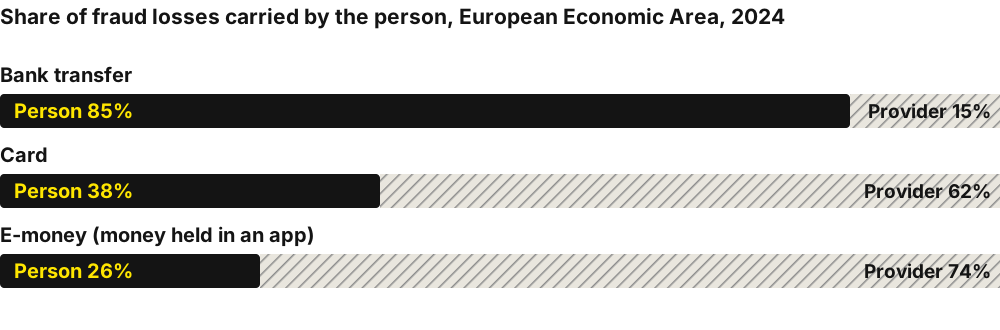
| 85% vs 38% | Share of fraud losses carried by the person: bank transfers against card payments (2024) European Economic Area · Official data | European Banking Authority and European Central Bank, 15 December 2025 |
| 77,484 to 388 | Investment scam adverts detected each week, 2024 peak to June 2026, after advertiser checks Taiwan · Official data | Ministry of Digital Affairs, Taiwan, 17 July 2026 |
The Data Desk is updated when each issuing body publishes new figures.
Free to reuse, repackage and publish, in any format and on any channel, for public safety, with a link to UtilForge.org. Creative Commons Attribution 4.0 International.